SIP Trunking for High-Volume Call Centers: Complete Guide
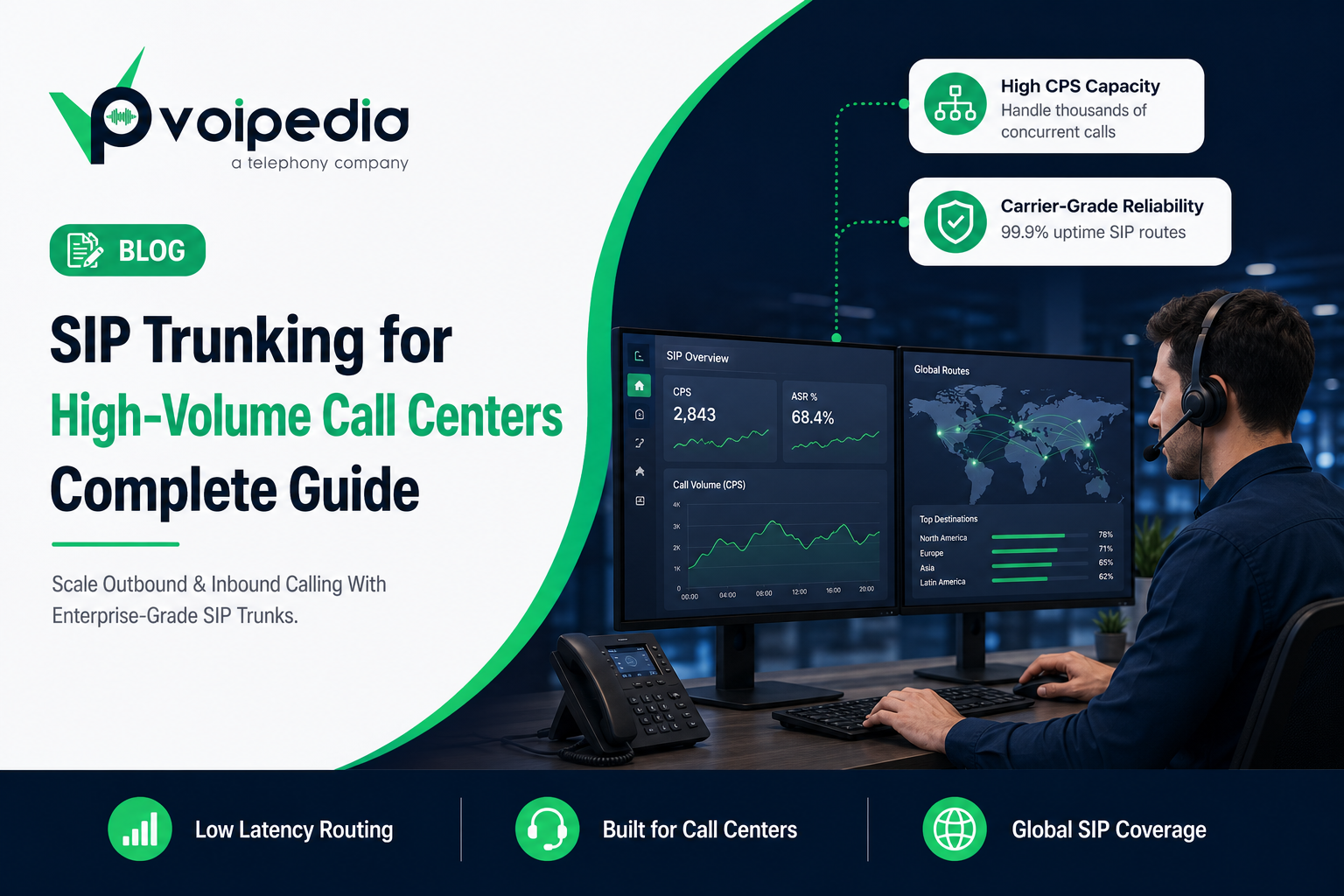
Choosing the right SIP trunking for call centers determines whether a dialer can hit peak call volume without dropped connections, throttled campaigns, or caller ID getting flagged as spam. This guide covers the metrics, sizing math, and features that separate generic SIP trunking from trunking actually built for call center traffic.
Key Takeaways
- SIP trunking replaces physical phone lines with a virtual, internet-based connection that carries call center voice traffic over SIP (Session Initiation Protocol).
- High-volume call centers need trunks sized for CPS (Calls Per Second), not just concurrent channel count — undersized CPS causes dropped dial attempts during peak hours.
- Core health metrics to track are ASR (Answer-Seizure Ratio), ACD (Average Call Duration), PDD (Post-Dial Delay), jitter, and packet loss.
- SIP trunks are generally more scalable and cost-efficient than PRI circuits, since capacity is added in software rather than physical hardware.
- STIR/SHAKEN caller ID authentication and CNAM/CLI management directly affect answer rates for outbound call centers.
- Redundant routing and automatic failover are non-negotiable for call centers where downtime means lost revenue.
What Is SIP Trunking for Call Centers?
SIP trunking is a method of delivering voice calls over an internet connection using the Session Initiation Protocol (SIP) instead of traditional copper phone lines or PRI circuits. A SIP trunk connects a business’s PBX or contact center platform to the public telephone network through a VoIP provider, allowing calls to be placed and received as digital data. For call centers, SIP trunking replaces fixed-line capacity with flexible, on-demand channels that scale with call volume.
Unlike a traditional phone line, a SIP trunk isn’t tied to a physical wire count. Capacity is defined by how many simultaneous calls (channels) and how many call attempts per second (CPS) the trunk is provisioned to handle — both of which can typically be adjusted without new hardware.
Why SIP Trunking for Call Centers Needs to Be Purpose-Built
A five-person office and a 200-seat outbound call center both use “SIP trunking,” but the traffic patterns are completely different. Call centers — especially those running predictive or progressive dialers — generate short bursts of many simultaneous call attempts, high daily call volume, and a much higher ratio of unanswered calls (no-answer, busy, voicemail) compared to a typical business line.
Generic SIP trunking, sized for standard office use, breaks down under these patterns in three common ways:
1. CPS Throttling
CPS (Calls Per Second) is the number of new call attempts a trunk can originate or receive each second. Predictive dialers can generate large bursts of outbound attempts in short windows. If a trunk’s CPS limit is too low, excess call attempts are queued or rejected outright, which shows up as dialer inefficiency rather than an obvious network fault.
2. Channel Exhaustion
Each simultaneous call — inbound or outbound — occupies one channel. If a call center runs out of available channels during a peak period, new calls simply cannot connect until a channel frees up, resulting in missed inbound calls or stalled outbound campaigns.
3. Caller ID and Answer Rate Problems
High-volume outbound dialing from a small pool of Caller ID (CLI) numbers is a common trigger for carriers and analytics platforms to label calls as “Spam Likely” or “Scam Likely.” Without proper STIR/SHAKEN attestation, CNAM registration, and CLI rotation practices, outbound call centers can see answer rates decline even when call quality itself is fine.
Key Metrics That Define Call Center SIP Trunk Performance
Call center operations teams typically monitor a specific set of SIP trunk metrics to catch problems before they affect campaign performance or customer experience.
| Metric | What It Measures | Why It Matters for Call Centers |
|---|---|---|
| CPS (Calls Per Second) | New call attempts originated/received per second | Undersized CPS throttles dialer output during peak campaigns |
| ASR (Answer-Seizure Ratio) | % of call attempts that are answered | Low ASR signals routing issues, bad number data, or carrier blocking |
| ACD (Average Call Duration) | Average length of connected calls | Helps forecast trunk capacity and agent staffing needs |
| PDD (Post-Dial Delay) | Time between dialing and the call connecting or ringing | High PDD frustrates agents and increases abandonment on outbound dialers |
| Jitter | Variation in the time between arriving audio packets | High jitter causes choppy or garbled call audio |
| Packet Loss | % of audio (RTP) packets that never arrive | Directly degrades voice clarity and can cause dropped calls |
| MOS (Mean Opinion Score) | 1–5 estimate of perceived call quality | A single, easy benchmark for overall call clarity |
Most of these metrics are visible in a SIP trunk provider’s real-time dashboard or CDR (Call Detail Record) reporting. Tracking them over time — not just in the moment — makes it possible to spot a slowly degrading route before it causes a full outage.
SIP Trunking vs. PRI vs. Traditional Phone Lines
Many call centers migrating off legacy infrastructure are comparing SIP trunking to PRI (Primary Rate Interface) circuits or analog lines. Here’s how they differ in practice.
| Factor | SIP Trunking | PRI | Analog Lines |
|---|---|---|---|
| Capacity scaling | Adjusted in software, often same-day | Fixed at 23 channels per circuit; adding capacity means new hardware | One line = one call, no scaling |
| Infrastructure | Internet/data connection | Dedicated physical circuit from a carrier | Dedicated physical copper line |
| Geographic flexibility | Works anywhere with internet access; supports remote/distributed agents | Tied to the physical location of the circuit | Tied to the physical line |
| Disaster recovery | Can reroute to backup locations or cloud failover | Limited; tied to physical circuit and location | No built-in failover |
| Typical cost structure | Pay for channels/usage actually needed | Pay for the full 23-channel block regardless of usage | Per-line recurring cost |
How to Size SIP Trunk Capacity for a Call Center
Under-provisioning a SIP trunk is one of the most common causes of call center connectivity issues. Two numbers matter most: concurrent channels and CPS.
Estimating Concurrent Channels
A commonly used starting formula is:
Concurrent Channels ≈ Number of Agents × Peak Concurrency Rate
Peak concurrency rate varies by call center type — a blended inbound/outbound floor typically runs lower than a pure predictive-dialer outbound floor, since dialers intentionally generate more simultaneous attempts than there are available agents. Outbound-heavy operations often provision noticeably more channels than agent seats to account for no-answers, voicemail detection, and abandoned calls.
Estimating CPS Requirements
CPS needs are driven by how quickly a dialer places new call attempts, not by headcount alone. A predictive dialer generating fast bursts of outbound attempts needs meaningful CPS headroom above its average rate — otherwise legitimate call attempts get queued or dropped during the burst, which looks like a dialer or carrier problem but is actually a trunk-sizing issue.
The safest approach is to request current CDR/CPS reporting from your existing provider (or run a controlled test with a new one) rather than guessing, since actual traffic patterns vary widely between inbound support desks, outbound sales floors, and blended BPO operations.
Must-Have Features in SIP Trunking for Call Centers
- Redundant routing and automatic failover — calls reroute through a secondary carrier path if a route degrades or fails, instead of dropping.
- High CPS capacity with headroom — sized for burst traffic from dialers, not just steady-state volume.
- STIR/SHAKEN attestation and CNAM/CLI management — supports caller ID trust and helps prevent legitimate business calls from being flagged as spam.
- Real-time CDR and quality reporting — visibility into ASR, PDD, jitter, and packet loss without waiting on a support ticket.
- Geographic and carrier route diversity — multiple underlying carrier paths reduce the risk of a single point of failure.
- DID and toll-free number support — the ability to provision local and toll-free numbers alongside trunk capacity for inbound campaigns.
SIP Trunk Pricing Models
SIP trunk pricing is generally structured in one of a few common ways, and call centers should evaluate which model fits their calling pattern:
- Per-channel pricing — a flat rate per concurrent channel, regardless of usage. Predictable for steady, high-utilization floors.
- Per-minute (usage-based) pricing — billed on actual call minutes. Can suit lower-volume or highly seasonal operations.
- Hybrid/committed models — a base channel commitment with usage-based billing beyond that threshold, common for call centers with variable but substantial volume.
Because rates vary by destination, traffic type (outbound vs. toll-free vs. international), and volume commitment, call centers should request quotes based on their actual CPS, channel, and destination mix rather than comparing generic list prices.
Frequently Asked Questions
What is SIP trunking used for in a call center?
SIP trunking connects a call center’s PBX or dialer platform to the public phone network over the internet, replacing physical phone lines. It’s used to handle both inbound customer calls and outbound campaign dialing at scale, without adding physical circuits for every increase in volume.
How many concurrent calls can a SIP trunk handle?
This depends entirely on how the trunk is provisioned — capacity is defined by the number of channels purchased, not a fixed physical limit like a PRI’s 23 channels. Call centers should size channels based on peak concurrent call volume, including outbound attempts that don’t connect.
What is a good ASR for a call center SIP trunk?
ASR benchmarks vary by campaign type, list quality, and destination, so there is no single universal number. A sudden or sustained drop in ASR compared to a trunk’s own historical baseline is generally a stronger signal of a routing or carrier issue than comparing against a generic industry figure.
Is SIP trunking cheaper than PRI for call centers?
Often, yes — SIP trunking lets a call center pay for the channels and usage it actually needs and scale up or down without new hardware, while PRI circuits are sold in fixed 23-channel blocks regardless of utilization. Actual savings depend on call volume, destinations, and the provider’s pricing model.
Why do our outbound calls show up as “Spam Likely”?
This is typically caused by high call volume from a small set of Caller ID numbers, missing STIR/SHAKEN attestation, or no CNAM registration — patterns that call analytics apps and carriers associate with robocalling. Proper caller ID authentication and CLI management reduce (but don’t guarantee elimination of) spam labeling.
What’s the difference between SIP trunk origination and termination?
Termination refers to carrying outbound calls from your call center to the called party. Origination refers to carrying inbound calls from a caller to your call center. Most call center SIP trunk packages include both directions, but they can have different pricing, routing, and quality considerations.
Do remote or distributed call center agents need different SIP trunking?
Not necessarily a different trunk, but distributed agents add more dependency on each agent’s individual internet connection quality, since SIP trunking is internet-based. Centralized SIP trunking still works for distributed teams, but call quality troubleshooting needs to account for each agent’s local network, not just the trunk itself.
Conclusion
SIP trunking gives call centers the flexibility to scale voice capacity with demand instead of being boxed in by fixed physical circuits — but only when the trunk is actually sized and configured for call center traffic patterns. Getting CPS, channel capacity, caller ID authentication, and failover right up front prevents the kind of connectivity issues that quietly erode dialer efficiency and customer experience.
Explore The Voipedia’s Outbound Calls solutions for high-volume dialing, or see how Inbound Calls and Cloud PBX fit into a complete call center communication stack. For caller trust and compliance context, see our guide on STIR/SHAKEN compliance.
Talk to The Voipedia about SIP trunking built for high-volume call center traffic.