DID Numbers vs Toll-Free Numbers: Which Is Right for Your Business?
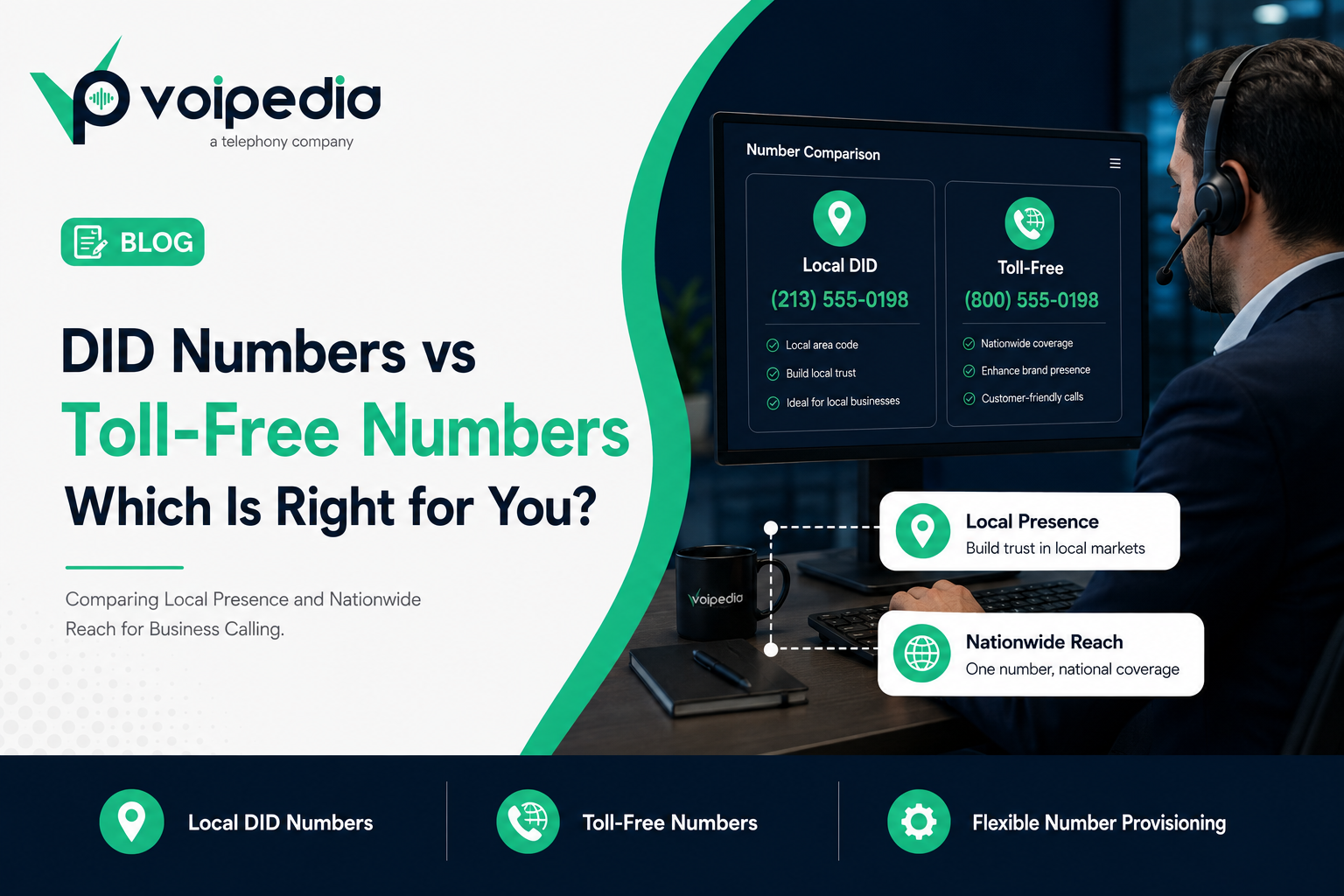
DID vs toll-free numbers: which should your business actually use? The honest answer is: it depends on who’s calling whom, and who you want to look like when they do. A DID (Direct Inward Dialing) number gives you a local or international presence tied to a specific city or country code. A toll-free number gives you one nationally recognized line where the business, not the caller, pays for the call. Most growing call centers and B2B companies eventually need both, but picking the wrong one first can quietly cost you answer rate, trust, or budget. This guide breaks down exactly how DID numbers and toll-free numbers differ, when each one wins, and how the decision changes once you’re provisioning numbers across markets like the United States, Brazil, the Philippines, and Egypt.
Key Takeaways: DID Numbers vs Toll-Free Numbers
- A DID number is a local or direct phone number tied to a specific city, region, or country code, routed straight to your PBX, agent, or call queue without going through a receptionist or operator.
- A toll-free number (800, 888, 877, 866, 855, 844, or 833 in the US) lets callers reach your business at no cost to them, with the business covering the call charges instead.
- DID numbers build local trust and typically cost less per line, making them well suited to outbound calling, local-presence strategies, and multi-city expansion.
- Toll-free numbers project a national, established brand image and remove any cost barrier for inbound callers, making them well suited to customer support, sales lines, and marketing campaigns.
- Most call centers and BPOs use both: DID numbers for outbound and regional presence, toll-free for the primary inbound support or sales line.
- For international operations, DID number availability and requirements vary by country, so businesses expanding into markets like Brazil, the Philippines, or Egypt need country-specific numbers, not just a US toll-free line.
What Is a DID Number?
A DID (Direct Inward Dialing) number is a phone number that routes calls directly to a specific extension, agent, or department on your PBX or SIP trunk, without requiring a shared switchboard. DID numbers use standard local or national area codes, so they look and function like an ordinary phone number tied to a specific city or country.
What Is a Toll-Free Number?
A toll-free number is a phone number, using a reserved code such as 800 or 888 in the US, that callers can dial for free, with the called business paying for the airtime instead of the caller. Toll-free numbers aren’t tied to any specific city, only to a country, so the same number works nationwide.
DID Numbers vs Toll-Free Numbers: Side-by-Side Comparison
Here’s how DID vs toll-free numbers stack up across the factors that actually affect a business phone strategy:
| DID (Local) Numbers | Toll-Free Numbers | |
|---|---|---|
| Who pays for the call | Shared between caller and business (standard call rates) | The business (caller pays nothing) |
| Geographic association | Tied to a specific city, region, or country code | Tied to a country, not a specific city |
| Caller perception | Feels local and familiar in that region | Feels established and nationally accessible |
| Best for | Outbound dialing, local-presence strategy, multi-city or multi-country expansion | Inbound support, sales lines, national marketing campaigns |
| Typical cost structure | Lower per-number cost, billed at local/standard rates | Higher, usage-based billing since the business absorbs call charges |
| Scalability across markets | Easy to provision many numbers across many cities/countries | Typically one or a small number of lines per country |
| Works well with | Cloud PBX, outbound dialers, click-to-call, regional sales teams | Customer support queues, IVR, brand advertising |
When to Choose DID (Local) Numbers
DID numbers make the most sense when local familiarity or per-city presence matters more than nationwide recognition:
- Outbound sales and collections calling, where a recognizable local area code makes prospects more comfortable answering an unfamiliar call.
- Expanding into new cities or countries without opening a physical office, by provisioning a local number for each market.
- Call centers running region-specific campaigns, where each campaign or client needs its own dedicated line for tracking and caller ID purposes.
- Cost-sensitive high-volume operations, where per-line DID pricing is typically lower than toll-free usage-based billing.
When to Choose Toll-Free Numbers
Toll-free numbers are the better fit when accessibility and brand consistency matter more than local presence:
- Customer support and helpdesk lines, where removing any cost barrier for the caller reduces friction.
- National marketing and advertising campaigns, where a single memorable number needs to work the same way regardless of where the customer is calling from.
- Businesses without a specific regional identity, where a local area code would be arbitrary rather than meaningful.
- Sales lines meant to look established, since a toll-free number is still widely associated with larger, more permanent businesses.
Using DID and Toll-Free Numbers Together
In practice, the DID vs toll-free numbers decision usually isn’t either/or. Most call centers and growing B2B companies don’t pick one over the other, they layer both into their number strategy. A common setup: a single toll-free number as the primary inbound line for the brand’s main support or sales queue, combined with local DID numbers assigned to outbound campaigns, regional offices, or specific agents. This gives inbound callers a consistent, cost-free number to remember, while outbound campaigns get the local-presence advantage that improves live answer rates. If you’re running outbound calling campaigns alongside a support line, this hybrid model is usually the more effective starting point than committing entirely to one number type.
International DID Numbers: Brazil, the Philippines, and Egypt
A US toll-free number doesn’t automatically give you a local presence, or even guaranteed reachability, in every country you do business with. Businesses expanding internationally generally need country-specific DID numbers alongside, or instead of, a toll-free line.
Brazil
Brazilian consumers are accustomed to local area-code numbers, and telecom numbering and portability in Brazil is regulated by ANATEL (Agencia Nacional de Telecomunicacoes). A local Brazilian DID number, mapped to the correct city code, reads as a legitimate local business rather than a foreign one, which matters for both sales outreach and customer support credibility.
Philippines
The Philippines is one of the largest BPO and contact-center markets in the world, and most outsourced operations there run on a mix of local Philippine DID numbers for domestic reach and international DID or toll-free numbers to serve clients’ customers abroad. For BPOs handling multiple client accounts, dedicated DID numbers per client or campaign also simplify call tracking and reporting.
Egypt
Egypt’s growing BPO and contact-center sector similarly relies on local DID numbers to serve the domestic market credibly, alongside international numbers for outbound or cross-border support operations. As with any international deployment, businesses should confirm current local numbering and routing requirements with their provider before launch, since requirements can change and this article isn’t a substitute for that verification.
Toll-Free Origination and Termination: What Businesses Should Know
Behind the scenes, toll-free calls rely on two distinct legs: toll-free termination, which is the process of routing an inbound call to the toll-free number’s owner, and toll-free origination, which covers how the call is set up and delivered from the caller’s carrier in the first place. In the US, toll-free numbers (referred to in the industry as “8YY” numbers, covering the 800/888/877/866/855/844/833 codes) are managed through a centralized registry, and calls are typically delivered over SIP trunks to the receiving business’s PBX or contact center platform. This matters operationally because toll-free call quality and reliability depend on the same signaling fundamentals as any other SIP-based call. If your toll-free line is dropping or rejecting calls, the same SIP response codes apply, see why VoIP calls get rejected for how to read those errors.
FAQ
What’s the main difference between a DID number and a toll-free number?
A DID number is tied to a specific local or regional area code and shares call costs between caller and business, while a toll-free number works nationwide under a reserved code and puts the full cost of the call on the business.
Are DID numbers cheaper than toll-free numbers?
Generally yes. DID numbers are typically billed at standard local or regional rates with lower per-line costs, while toll-free numbers are usage-based and the business absorbs the caller’s cost, which usually makes them more expensive at scale.
Can a business use both DID and toll-free numbers?
Yes, and most call centers do. A common approach is a toll-free number as the main inbound support or sales line, paired with local DID numbers for outbound campaigns, regional offices, or per-client tracking.
Do toll-free numbers work for international calls?
US toll-free numbers are generally only free to dial from within the US (and sometimes Canada). Callers dialing from other countries, or wireless callers without unlimited plans, may still be charged, and a US toll-free number does not substitute for a genuine local presence in another country.
Which is better for a call center: DID or toll-free numbers?
It depends on the call center’s mix of inbound and outbound work. Outbound-heavy operations benefit more from local DID numbers to improve live answer rates, while inbound support and sales queues typically perform better with a toll-free number as the primary line.
Do I need local DID numbers for every country I operate in?
If local trust, credibility, or in-country reachability matters for that market, yes, a local DID number is usually the better choice over relying solely on a foreign toll-free or international number.
What is a subscriber number?
Subscriber number is another common industry term for a direct local phone number assigned to a business or individual, functionally equivalent to a DID number, and used interchangeably by some providers, including The VoIPedia.
Conclusion
There’s no universally “better” answer to DID vs toll-free numbers, only a better fit for what the number needs to do. If the goal is local trust, cost efficiency, and multi-market expansion, DID numbers win. If the goal is nationwide accessibility and a consistent inbound brand line, toll-free wins. Most serious call center and B2B operations end up running both, deployed deliberately rather than defaulting to whichever number was easiest to buy first. The VoIPedia provides Dedicated Lines, Subscriber Numbers (DID), and Toll-Free Numbers across countries with active mobile or landline service, including the US, Brazil, the Philippines, and Egypt. Talk to The VoIPedia about building the right number mix for your call center or business expansion.