SIP Trunking for Philippine BPOs: The Complete Setup Guide
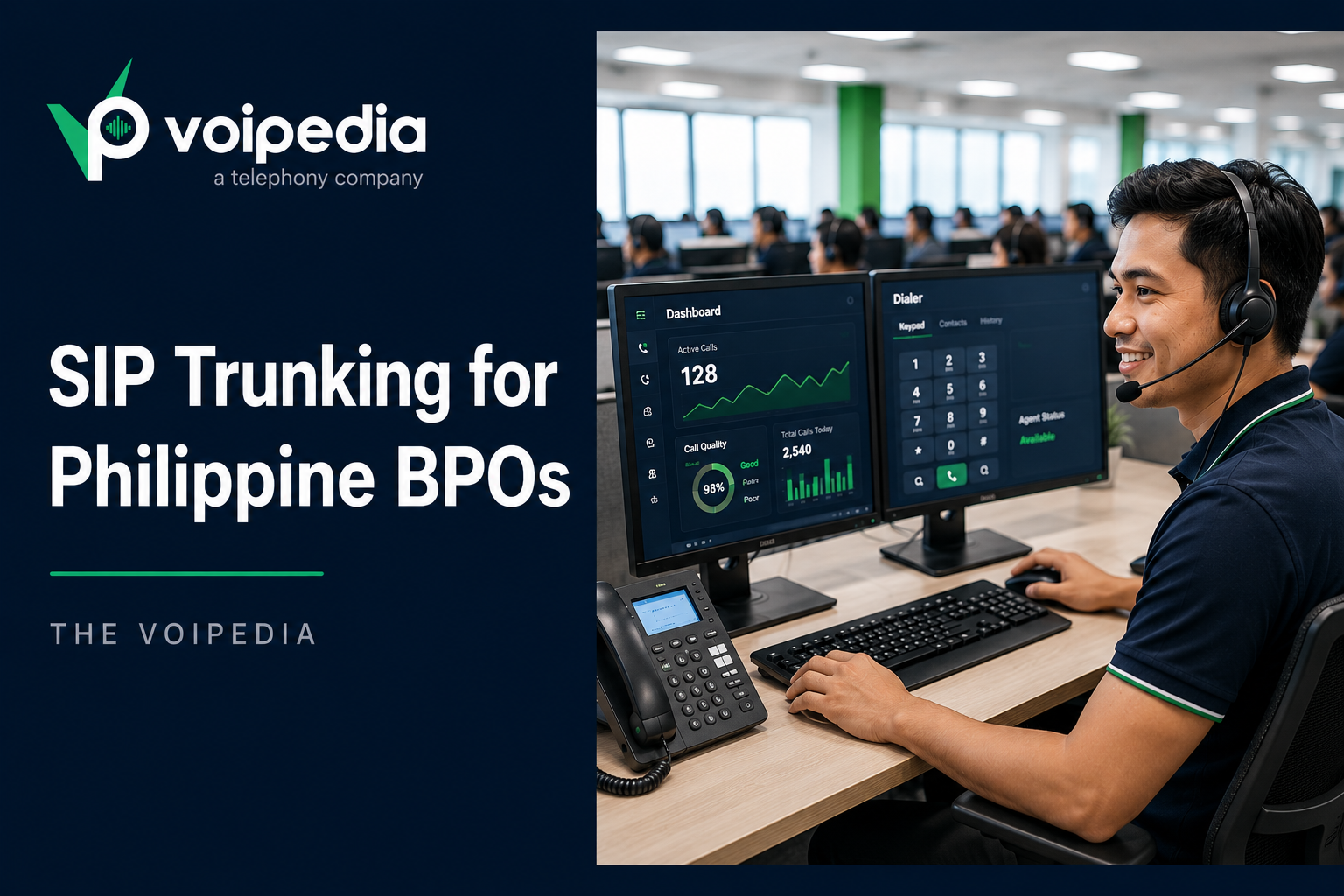
A Philippine BPO doesn’t fail on SIP trunking because of distance — it fails because of two things nobody warns new operators about: choosing the wrong codec for a trans-Pacific route, and letting outbound calls leave Manila or Cebu with a caller ID the receiving US carrier can’t verify. The first costs you call quality. The second gets your agents’ calls marked “Spam Likely” before a customer ever picks up. This guide covers SIP trunking for Philippine BPOs end to end: codec selection, latency expectations, the caller ID/attestation problem specific to internationally-originated traffic, and how to structure inbound numbers for US, UK, or AU clients.
Key Takeaways
- SIP trunking lets a Manila- or Cebu-based BPO assign local US, UK, or AU numbers to agents, giving offshore teams a domestic caller presence without opening a physical office.
- The biggest operational risk isn’t cost — it’s outbound calls getting tagged Spam Likely or Scam Likely because the receiving carrier can’t verify the caller ID under STIR/SHAKEN.
- G.729 is the practical default codec for high-density PH-to-US trunks; G.711 gives cleaner audio but needs roughly eight times the bandwidth per call.
- Round-trip latency on Philippines-to-US routes typically runs 150–220ms; jitter buffer tuning matters more than the raw distance.
- CPS (calls per second), ASR (Answer Seizure Ratio), and PDD (Post Dial Delay) are the trunk metrics that actually predict whether a high-volume dialer campaign holds up under load.
- Most Philippine BPOs need both DID numbers and toll-free numbers — they solve different inbound problems, not the same one.
What Is SIP Trunking for Philippine BPOs?
SIP trunking connects a Philippine BPO’s PBX to the public telephone network over the internet instead of physical phone lines. A single trunk carries multiple simultaneous calls as SIP (Session Initiation Protocol, defined in IETF RFC 3261) signaling plus RTP audio, letting a BPO assign local numbers in a client’s country — a US area code, for instance — to agents sitting anywhere in the Philippines, and scale concurrent call capacity up or down without installing new lines.
Why Philippine BPOs Depend on SIP Trunking
The Philippine IT-BPM sector is one of the country’s largest employment industries and a large share of that work is voice-based customer support, technical support, and outbound campaigns for clients in the US, UK, and Australia. Much of it operates out of PEZA-registered (Philippine Economic Zone Authority) IT parks in Metro Manila, Cebu, Clark, and increasingly Davao. None of that works over traditional PSTN lines at scale — a campaign that needs to go from 50 to 150 agents for a seasonal spike can’t wait on a telco to run new copper.
| Factor | Traditional PSTN/Landline | SIP Trunking |
|---|---|---|
| Adding call capacity | New physical lines, technician visit, days to weeks | Provision more concurrent channels remotely, often same-day |
| Local presence in client’s country | Requires a physical office or leased line there | US/UK/AU DID numbers assigned to PH-based agents instantly |
| Scaling for seasonal campaigns | Fixed line count, hard to flex | Elastic concurrent-channel and CPS limits |
| International call routing | Per-minute PSTN termination via multiple carrier hops | Wholesale VoIP termination, typically fewer hops and lower cost at volume |
| Failover | Often a single point of failure | Multiple carrier routes and SBC-level failover are configurable |
Technical Setup: What Actually Matters on a PH-to-US Trunk
Codec Selection: G.711 vs. G.729
Codec choice determines how much bandwidth each concurrent call consumes — a bigger deal on a 150-seat floor than a 5-seat office.
| Codec | Bandwidth per Call | Audio Quality | Best For |
|---|---|---|---|
| G.711 (µ-law/A-law) | ~64 kbps | Highest — uncompressed | Smaller floors with strong, dedicated uplink bandwidth |
| G.729 | ~8 kbps | Good, compressed | High-density BPO floors where per-agent bandwidth is shared or constrained |
Most SIP trunk providers support automatic codec negotiation, so a trunk can offer both and let each call settle on whichever the far end supports — but if bandwidth is tight across a large floor, forcing G.729 as the preferred codec avoids congestion before it happens.
Latency, Jitter, and Trans-Pacific Routing
Round-trip latency from the Philippines to US carrier networks typically falls in the 150–220ms range, driven mostly by submarine cable routing rather than anything on the BPO’s LAN. That range is well within what a well-configured jitter buffer (commonly 60–120ms) can smooth into a clean call — the calls that sound bad usually aren’t suffering from distance, they’re suffering from a jitter buffer that’s misconfigured or a trunk provider without dedicated trans-Pacific peering.
SIP Registration vs. IP Authentication
A trunk connects to a provider one of two ways: SIP registration (username/password, useful when the PBX’s public IP changes) or IP authentication (the provider whitelists a static IP, common for dedicated PEZA data-center connections). Most providers support both simultaneously, so a BPO can register desk-based agents while whitelisting the data center’s static IP for the PBX itself.
Reading Trunk Performance: CPS, ASR, and PDD
For outbound-heavy BPO campaigns, three metrics tell you whether a trunk can actually handle your dialer, not just whether it’s “up”: CPS (Calls Per Second — how many new call attempts the trunk can accept before throttling), ASR (Answer Seizure Ratio — the percentage of attempted calls that get answered, a leading indicator of route quality), and PDD (Post Dial Delay — the time between dialing and the call ringing, where a spike often signals carrier congestion). A deeper breakdown of these metrics, plus ACD and carrier routing, is covered in our guide to SIP trunking for high-volume call centers. If calls are failing outright rather than just running slow, the cause is usually a specific SIP response code — see why VoIP calls get rejected for how to read 403, 404, and 503 errors.
The Caller ID Problem: Why Philippine BPO Calls Get Marked “Spam Likely”
This is the issue that actually derails PH-based outbound campaigns, and it’s rarely explained clearly. US carriers score every inbound call using STIR/SHAKEN (the FCC’s caller ID authentication framework), which attaches an attestation level based on how confident the originating carrier is that the caller actually owns the number it’s displaying.
Attestation Levels Explained
| Attestation Level | What It Means | Typical Philippine BPO Scenario |
|---|---|---|
| A — Full | Carrier verifies the customer’s identity and confirms the customer is authorized to use the calling number | Achievable when a SIP trunk provider verifies number ownership directly under the BPO’s business account |
| B — Partial | Carrier verifies the customer’s identity but cannot confirm the customer owns the calling number | Common when a BPO leases US DIDs through its SIP trunk provider under a documented, verified account |
| C — Gateway | Carrier can only verify where the call entered the US network, not who originated it | Default outcome for traffic entering through an international gateway with no visibility into the originating customer — this is where most unmanaged PH-to-US traffic lands |
Fixing the Attestation Problem
Gateway (C) attestation is exactly what triggers Spam Likely and Scam Likely labels on the receiving end, even when the agent making the call is legitimate. It isn’t a penalty for calling from the Philippines — it’s a consequence of the trunk provider not being able to prove number ownership to the US carrier. The fix is choosing a provider who documents number ownership under your business account and signs traffic to achieve B or A attestation rather than defaulting every call to gateway status. Our STIR/SHAKEN compliance guide covers the framework in more depth, and if outbound campaigns are also subject to US TCPA/DNC rules, our TCPA and DNC compliance checklist is worth reviewing alongside this. This is general technical information, not legal advice — confirm specific compliance obligations with qualified counsel or the relevant regulator.
DID Numbers and Toll-Free Numbers for Inbound Support
Inbound is a separate design decision from outbound, and most Philippine BPOs need both number types rather than picking one:
- DID numbers give individual agents, account managers, or departments a direct local number in the client’s country — useful for account-based support where a customer expects to reach the same line.
- Toll-free numbers give the BPO’s client a single free-to-call hotline for general customer support, which is what most US consumers expect from a support line.
The tradeoffs between the two — cost structure, routing behavior, and use case — are covered in detail in our DID numbers vs. toll-free numbers comparison.
Choosing a SIP Trunk Provider for a Philippine BPO
Beyond price per minute, the questions that actually predict whether a provider will work at scale:
- Does the provider document and verify number ownership, or does every call default to gateway attestation?
- What concurrent channel and CPS limits does the trunk support, and do they match your dialer’s peak load, not just average load?
- Does the provider offer dedicated trans-Pacific routing, or generic international transit with unpredictable latency?
- Is support available during Philippine business hours, not just US time zones?
- Can the provider supply both DID and toll-free numbers under one account, or will inbound require a second vendor?
These are the same questions we work through with BPOs evaluating VoIPedia’s outbound calling, inbound calling, and cloud PBX solutions for Philippines-to-US operations.
FAQ
What is SIP trunking for a Philippine BPO?
SIP trunking connects a Philippine BPO’s PBX to the public telephone network over the internet, carrying multiple simultaneous calls without physical phone lines. It lets a BPO assign local numbers in a client’s country — such as a US area code — to Philippines-based agents, and scale call capacity up or down on demand.
Why do outbound calls from Philippine call centers get marked “Spam Likely”?
Most unmanaged traffic entering the US network from an international gateway receives only “Gateway” (C) attestation under STIR/SHAKEN, because the originating carrier can’t verify the caller actually owns the number being displayed. US carriers weight gateway attestation heavily when flagging calls as Spam Likely or Scam Likely. Using a trunk provider that verifies number ownership under your business account reduces this.
Which codec is better for Philippines-to-US SIP trunks, G.711 or G.729?
G.711 delivers the highest audio quality but uses about 64 kbps per call; G.729 compresses to roughly 8 kbps with a small quality tradeoff. High-density BPO floors with shared or limited bandwidth generally default to G.729, while smaller offices with strong dedicated bandwidth can use G.711.
Can a Philippine BPO use US toll-free numbers?
Yes. US toll-free numbers (800, 888, 877, 866, 855, 844, 833) can be provisioned through a SIP trunk provider and delivered to Philippines-based agents like any other inbound number, letting US customers call a free-to-them support line answered offshore.
What’s the difference between SIP registration and IP authentication?
SIP registration authenticates a trunk connection with a username and password, useful when the PBX’s public IP address changes. IP authentication whitelists a specific static IP address, common for dedicated data-center connections. Most providers support both at once.
What latency should a Philippines-to-US SIP trunk expect?
Round-trip latency typically runs 150–220ms, mostly driven by submarine cable routing. This range supports clean call quality when paired with a properly configured jitter buffer, usually in the 60–120ms range.
Do Philippine BPOs need to comply with US STIR/SHAKEN rules?
STIR/SHAKEN attestation is applied by the carriers handling a call within the US telephone network, including calls originating internationally that enter through a US gateway. A Philippine BPO doesn’t sign the call itself, but the SIP trunk provider’s ability to verify number ownership directly affects whether the BPO’s calls get flagged as spam on the receiving end.
What is CPS and why does it matter for outbound dialing?
CPS (Calls Per Second) is the rate at which a trunk can accept new outbound call attempts before throttling them. A high-volume dialer campaign that exceeds a trunk’s CPS limit will see calls queue, delay, or fail outright — regardless of how many concurrent channels are available.
Getting SIP Trunking for Philippine BPOs Right From Day One
Codec choice and latency are solvable with configuration. Caller ID attestation isn’t — it has to be built into the trunk provider relationship from the start, or every outbound campaign inherits the same Spam Likely problem. Explore The VoIPedia’s SIP trunking, DID, and toll-free solutions built for Philippines-to-US call center operations, or talk to our team about setting up trunks with proper caller ID attestation from day one.