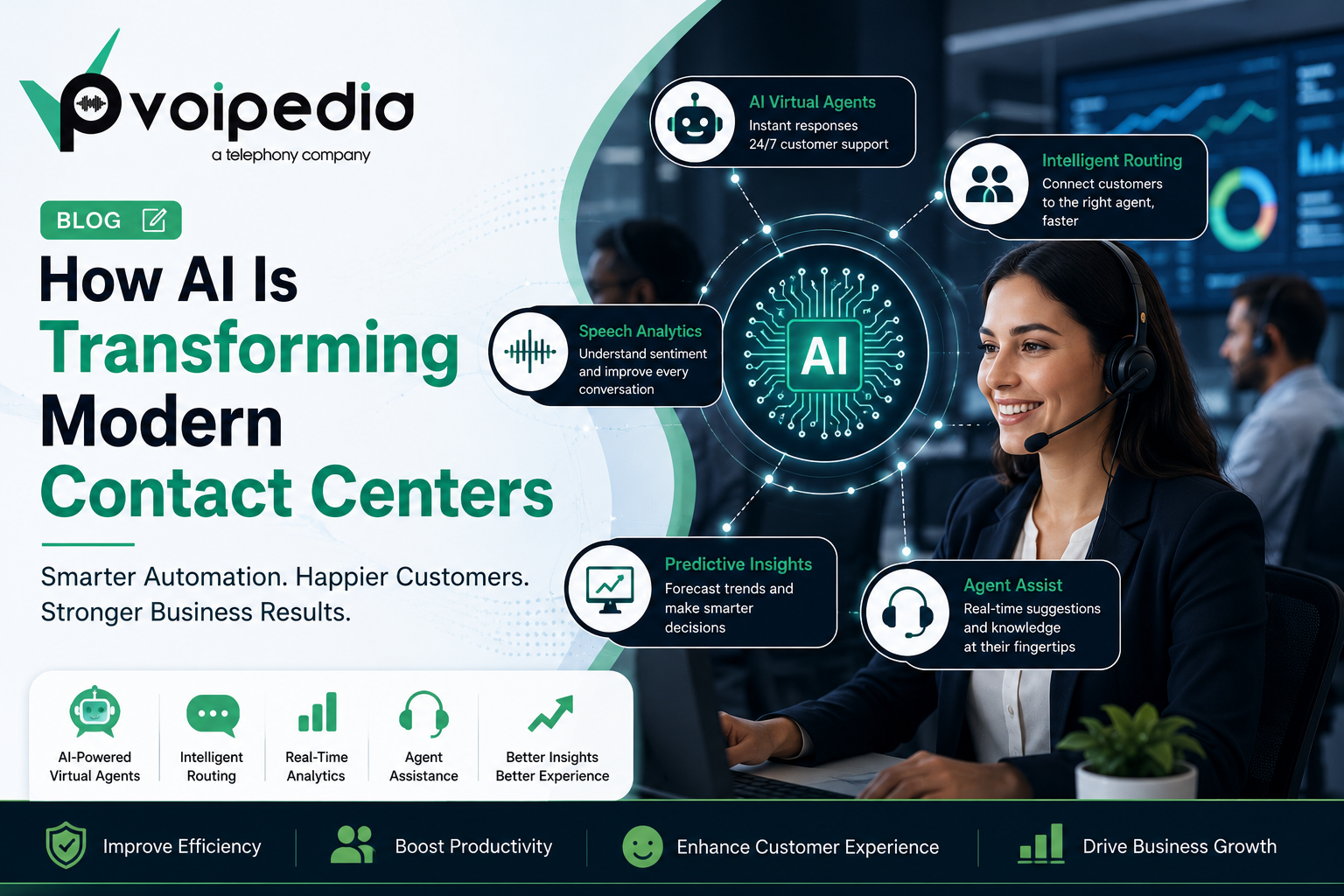
How AI Is Transforming Modern Contact Centers

Customer expectations have changed dramatically over the past few years. People no longer want to wait on hold for long periods, repeat information to multiple agents, or deal with slow support systems. Businesses are under pressure to provide faster responses, personalized experiences, and 24/7 customer service across multiple communication channels.

This shift is exactly why AI is transforming modern contact centers.

Artificial Intelligence is no longer just an experimental technology in customer support. Today, AI-powered systems are helping contact centers automate repetitive tasks, improve agent performance, reduce operational costs, and deliver better customer experiences at scale.

From AI voice assistants to real-time analytics and predictive routing, modern contact centers are evolving faster than ever before.

What Is AI in Contact Centers?

AI in contact centers refers to the use of artificial intelligence technologies to automate, analyze, and optimize customer communication processes.

AI-powered systems can:

  • Understand customer intent
  • Route calls intelligently
  • Analyze conversations in real time
  • Automate repetitive support tasks
  • Detect customer sentiment
  • Improve agent productivity
  • Predict customer behavior

These technologies work across:

  • Voice calls
  • Live chat
  • SMS
  • Email
  • Social media
  • Omnichannel communication platforms

Modern cloud communication systems are increasingly integrating AI into their infrastructure to improve efficiency and customer satisfaction.

You can also learn more about cloud communication systems in our article:
https://thevoipedia.com/cloud-pbx-vs-traditional-phone-systems/

Why Contact Centers Are Adopting AI

Traditional contact centers face several major challenges:

  • High operational costs
  • Long wait times
  • Agent burnout
  • Poor customer experiences
  • Inconsistent service quality
  • Rising support volumes

AI helps solve many of these problems by automating repetitive workflows and improving decision-making processes.

According to IBM, AI-powered customer support systems can significantly improve efficiency while reducing response times.
https://www.ibm.com/topics/contact-center-ai

AI-Powered Virtual Agents and Chatbots

One of the biggest changes in modern contact centers is the rise of AI virtual agents.

AI chatbots and voice bots can:

  • Answer common customer questions
  • Handle account inquiries
  • Process payments
  • Schedule appointments
  • Provide order updates
  • Resolve simple support requests

Unlike traditional IVR systems, modern AI assistants use natural language processing (NLP) to understand customer intent and respond conversationally.

This allows businesses to provide instant support without requiring human agents for every interaction.

Real-Time Speech Analytics

AI-powered speech analytics is transforming how businesses monitor customer interactions.

Modern AI systems can analyze conversations in real time to identify:

  • Customer sentiment
  • Compliance risks
  • Agent performance
  • Escalation triggers
  • Sales opportunities
  • Customer frustration

Supervisors can receive live alerts during calls, allowing them to intervene before problems escalate.

Speech analytics also helps businesses improve training and quality assurance processes.

Intelligent Call Routing

Traditional call routing often sends customers through complex menus before connecting them to the right department.

AI-driven routing systems analyze:

  • Customer intent
  • Previous interactions
  • Caller history
  • Language preferences
  • Sentiment data

This helps route calls to the most appropriate agent faster, improving both efficiency and customer satisfaction.

Businesses looking to optimize call delivery can also benefit from advanced VoIP routing strategies:
https://thevoipedia.com/what-is-call-routing/

AI Improves Agent Productivity

AI is not replacing agents entirely — in many cases, it is helping them work more efficiently.

Modern AI systems assist agents by:

  • Generating real-time call summaries
  • Suggesting responses
  • Displaying customer history
  • Providing knowledge base recommendations
  • Automating after-call work
  • Transcribing conversations automatically

This reduces manual workload and allows agents to focus more on customer engagement.

Predictive Analytics in Contact Centers

AI-powered predictive analytics helps businesses forecast customer behavior and operational trends.

Contact centers can use AI to predict:

  • Call volume spikes
  • Customer churn risks
  • Staffing requirements
  • Sales opportunities
  • Customer satisfaction levels

This helps businesses make smarter operational decisions while improving resource management.

AI Voice Assistants Are Replacing Legacy IVR Systems

Traditional IVR systems often frustrate customers because they rely on rigid menu structures.

Modern AI voice assistants provide a much more natural experience by allowing callers to speak conversationally.

Instead of:
“Press 1 for billing.”

Customers can simply say:
“I need help with my payment.”

AI systems can then understand intent and route the call appropriately.

This creates faster and more personalized customer experiences.

AI Helps Reduce Operational Costs

One major reason businesses invest in AI is cost reduction.

AI systems help reduce:

  • Agent workload
  • Average handling time
  • Call abandonment rates
  • Training costs
  • Repetitive manual tasks

This allows contact centers to scale operations more efficiently without dramatically increasing staffing costs.

AI and Omnichannel Customer Support

Modern customers expect support across multiple channels.

AI-powered omnichannel systems can manage interactions across:

  • Voice
  • Email
  • Chat
  • SMS
  • WhatsApp
  • Social media

AI helps maintain consistent customer experiences across all communication channels.

Challenges of AI in Contact Centers

Although AI offers significant advantages, implementation also comes with challenges.

Data Privacy and Security

AI systems often process sensitive customer information, making data protection critical.

Businesses must ensure:

  • Secure infrastructure
  • Regulatory compliance
  • Data encryption
  • Access control

Integration Complexity

Many businesses still operate on legacy communication systems that may not integrate easily with modern AI platforms.

Migration planning is often necessary.

Human Oversight Is Still Important

AI can automate many tasks, but human agents remain essential for:

  • Complex support cases
  • Emotional interactions
  • High-value sales conversations
  • Escalation handling

The best contact centers combine AI efficiency with human expertise.

The Future of AI in Contact Centers

AI adoption in contact centers will continue growing rapidly over the next few years.

Future innovations may include:

  • Emotion-aware AI systems
  • Fully conversational voice agents
  • Real-time language translation
  • Hyper-personalized customer interactions
  • Advanced predictive customer support
  • AI-driven workforce optimization

Businesses that adopt AI early will likely gain a significant competitive advantage in customer experience and operational efficiency.

Final Thoughts

AI is fundamentally transforming modern contact centers.

From intelligent routing and speech analytics to virtual agents and predictive analytics, AI technologies are helping businesses improve customer experiences while reducing operational complexity.

As customer expectations continue evolving, contact centers that rely entirely on traditional systems may struggle to remain competitive.

The future of customer communication is increasingly AI-driven, data-focused, and highly automated.

For businesses looking to scale customer support operations efficiently, AI is no longer optional — it is becoming a core part of modern contact center infrastructure.
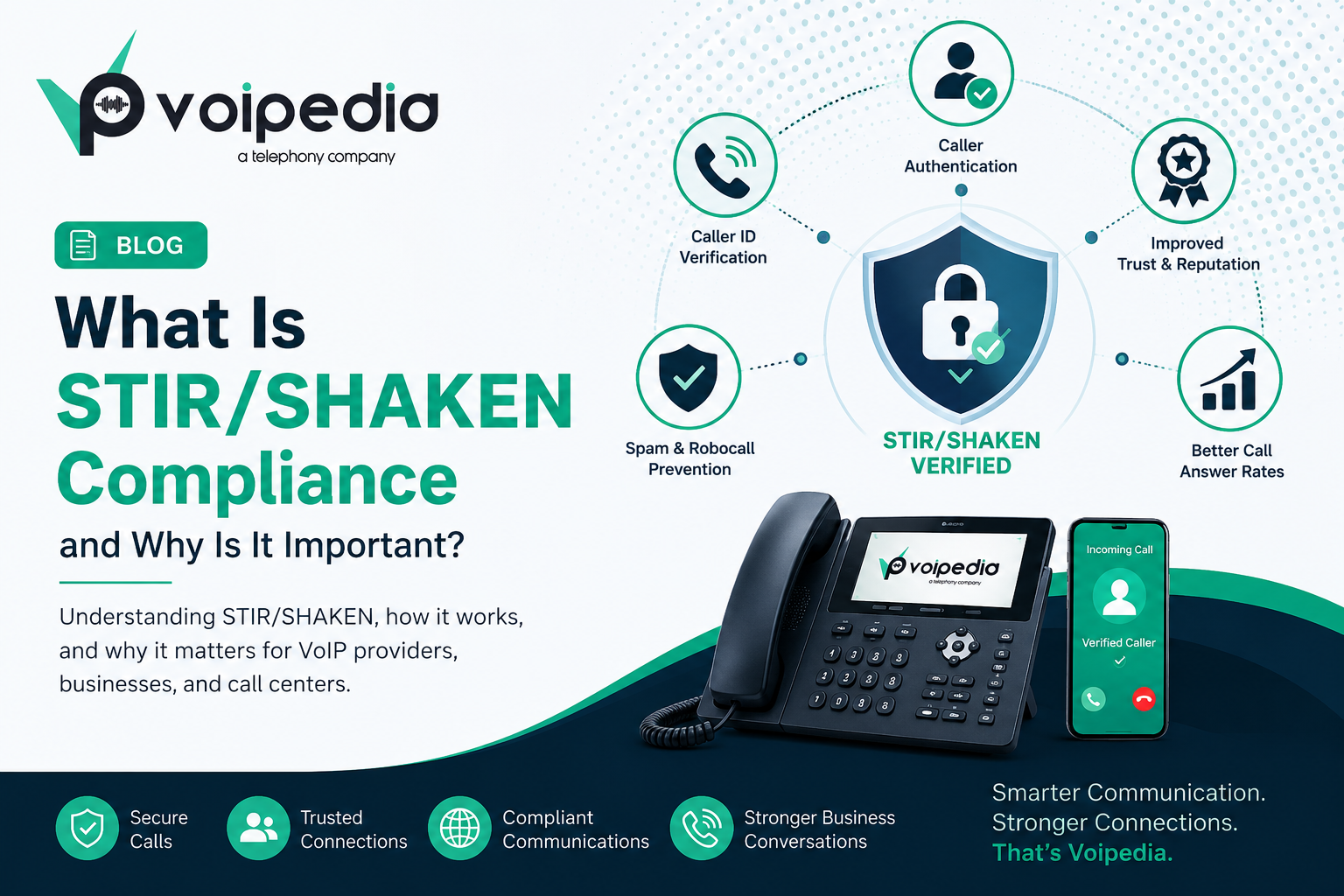
What Is STIR/SHAKEN Compliance and Why Is It Important?

Businesses today depend heavily on voice communication, but trust in phone calls has declined dramatically over the last few years. Spam calls, robocalls, and caller ID spoofing have made customers hesitant to answer unknown numbers. This growing telecom problem is exactly why STIR/SHAKEN compliance has become essential for modern VoIP providers, SIP carriers, contact centers, and enterprise communication systems.

STIR/SHAKEN is designed to verify caller identity, reduce spoofed calls, and help telecom providers restore trust in voice communication. As regulations tighten and carriers become stricter about spam prevention, businesses that ignore STIR/SHAKEN compliance may face lower answer rates, spam labeling, and reduced call deliverability.

If your company uses VoIP services or outbound calling systems, understanding how STIR/SHAKEN works is no longer optional.

You can also learn more about modern communication infrastructure in our guide on
https://thevoipedia.com/cloud-pbx-vs-traditional-phone-systems/

What Is STIR/SHAKEN Compliance?

STIR/SHAKEN is a caller authentication framework used to verify that a phone call is genuinely coming from the number displayed on caller ID.

The framework combines two telecom standards:

  • STIR — Secure Telephone Identity Revisited
  • SHAKEN — Signature-based Handling of Asserted Information Using toKENs

Together, these standards help telecom providers digitally sign and verify calls across IP-based VoIP networks.

The Federal Communications Commission (FCC) introduced STIR/SHAKEN as part of its broader effort to reduce illegal robocalls and caller ID spoofing.
https://www.fcc.gov/call-authentication

Why STIR/SHAKEN Was Introduced

Before STIR/SHAKEN, scammers could easily manipulate caller IDs using VoIP systems. Fraudsters often impersonated:

  • Banks
  • Government agencies
  • Healthcare providers
  • Insurance companies
  • Customer support teams

As spoofing became more common, customers stopped trusting incoming calls. Even legitimate businesses began struggling with declining answer rates.

Telecom providers and regulators needed a scalable solution that could authenticate caller identity across modern SIP networks. STIR/SHAKEN was created to solve this growing issue.

Businesses using scalable communication platforms like modern cloud PBX systems are increasingly adopting authentication frameworks to improve call trust and delivery.
https://thevoipedia.com/global-voip-solutions-businesses/

How STIR/SHAKEN Works

The STIR/SHAKEN framework works through digital certificates and SIP authentication.

Here’s a simplified process:

  1. A VoIP call is initiated.
  2. The originating provider verifies the customer.
  3. The provider digitally signs the call.
  4. A SIP Identity header and PASSporT token are attached.
  5. The receiving carrier verifies the signature.
  6. The call receives a trust verification level.

This entire process happens in milliseconds without affecting audio quality or call performance.

Understanding STIR/SHAKEN Attestation Levels

One of the most important aspects of STIR/SHAKEN compliance is attestation.

Attestation levels indicate how confidently the originating provider can verify the caller identity.

Full Attestation (A-Level)

The provider:

  • Knows the customer
  • Authenticated the customer
  • Confirms ownership of the phone number

This is the highest trust level.

Partial Attestation (B-Level)

The provider knows the customer but cannot fully verify ownership of the caller ID number.

Gateway Attestation (C-Level)

The provider received the call from another network and cannot verify the original caller.

Calls with lower attestation levels are more likely to trigger spam analytics systems.

More technical details about STIR/SHAKEN standards can be found here:
https://sti-ga.atis.org/

Why STIR/SHAKEN Compliance Is Important

Better Call Answer Rates

One of the biggest benefits of STIR/SHAKEN compliance is improved call answer rates.

Modern carriers increasingly prioritize authenticated traffic. Calls without verification are more likely to:

  • Display “Spam Likely”
  • Be blocked
  • Receive lower trust scores
  • Experience poor connection rates

For outbound sales teams and call centers, this directly impacts campaign performance and revenue generation.

Caller ID Spoofing Prevention

Caller ID spoofing damages customer trust and brand reputation.

STIR/SHAKEN helps telecom providers reduce fraudulent impersonation attempts and improve the credibility of legitimate business calls.

Regulatory Compliance

In the United States, the FCC requires many voice service providers to implement STIR/SHAKEN on IP-based networks as part of robocall mitigation requirements.

Failure to comply can create operational and regulatory risks for telecom providers and VoIP businesses.

Additional information about telecom identity frameworks can be found here:
https://www.iconectiv.com/stir-shaken

Improved Carrier Reputation

Carriers constantly analyze traffic quality.

Businesses sending authenticated traffic often experience:

  • Better routing quality
  • Improved termination rates
  • Lower spam labeling
  • Stronger carrier relationships

This is especially important for companies operating large outbound call campaigns.

Why Call Centers Need STIR/SHAKEN

Modern contact centers rely heavily on outbound communication.

Without caller authentication, even legitimate business calls may appear suspicious to recipients. This results in:

  • Lower pickup rates
  • Reduced agent productivity
  • Increased spam labeling
  • Poor campaign performance

STIR/SHAKEN compliance helps contact centers maintain trusted outbound communication while improving answer rates.

Common Challenges with STIR/SHAKEN

Legacy Infrastructure

Older telecom systems based on TDM or SS7 networks may face interoperability challenges when integrating STIR/SHAKEN.

International Traffic

Cross-border authentication remains complex because countries implement different telecom verification standards.

Spam Analytics Still Matter

Even authenticated calls can still be flagged if dialing behavior appears suspicious.

Carriers also evaluate:

  • Complaint rates
  • Call frequency
  • Traffic patterns
  • Consumer feedback

This means businesses must combine authentication with responsible outbound practices.

Does STIR/SHAKEN Stop All Robocalls?

No.

STIR/SHAKEN significantly reduces caller ID spoofing, but it does not eliminate all robocalls.

Scammers may still:

  • Use valid phone numbers
  • Exploit compromised systems
  • Route traffic internationally
  • Abuse non-IP networks

However, STIR/SHAKEN remains one of the most important telecom security improvements introduced in recent years.

Best Practices for STIR/SHAKEN Compliance

Businesses can improve their telecom reputation by:

  • Using verified caller IDs
  • Maintaining compliant dialing practices
  • Monitoring spam analytics
  • Working with trusted SIP carriers
  • Registering outbound campaigns
  • Avoiding aggressive robocall behavior

The Future of STIR/SHAKEN

The telecom industry continues evolving toward stronger caller verification systems.

Future developments may include:

  • Verified branded calling
  • Rich call data
  • AI-driven fraud prevention
  • Enhanced cross-border authentication
  • Advanced telecom identity frameworks

The long-term goal is clear: restore trust in voice communication.

Final Thoughts

STIR/SHAKEN compliance has become a critical part of modern VoIP infrastructure.

As robocalls and caller ID spoofing continue affecting the telecom industry, businesses must prioritize authenticated voice communication to maintain answer rates, customer trust, and carrier reputation.

For VoIP providers, SIP trunk operators, cloud PBX platforms, and enterprise contact centers, STIR/SHAKEN is no longer just a regulatory requirement — it is becoming a business necessity.