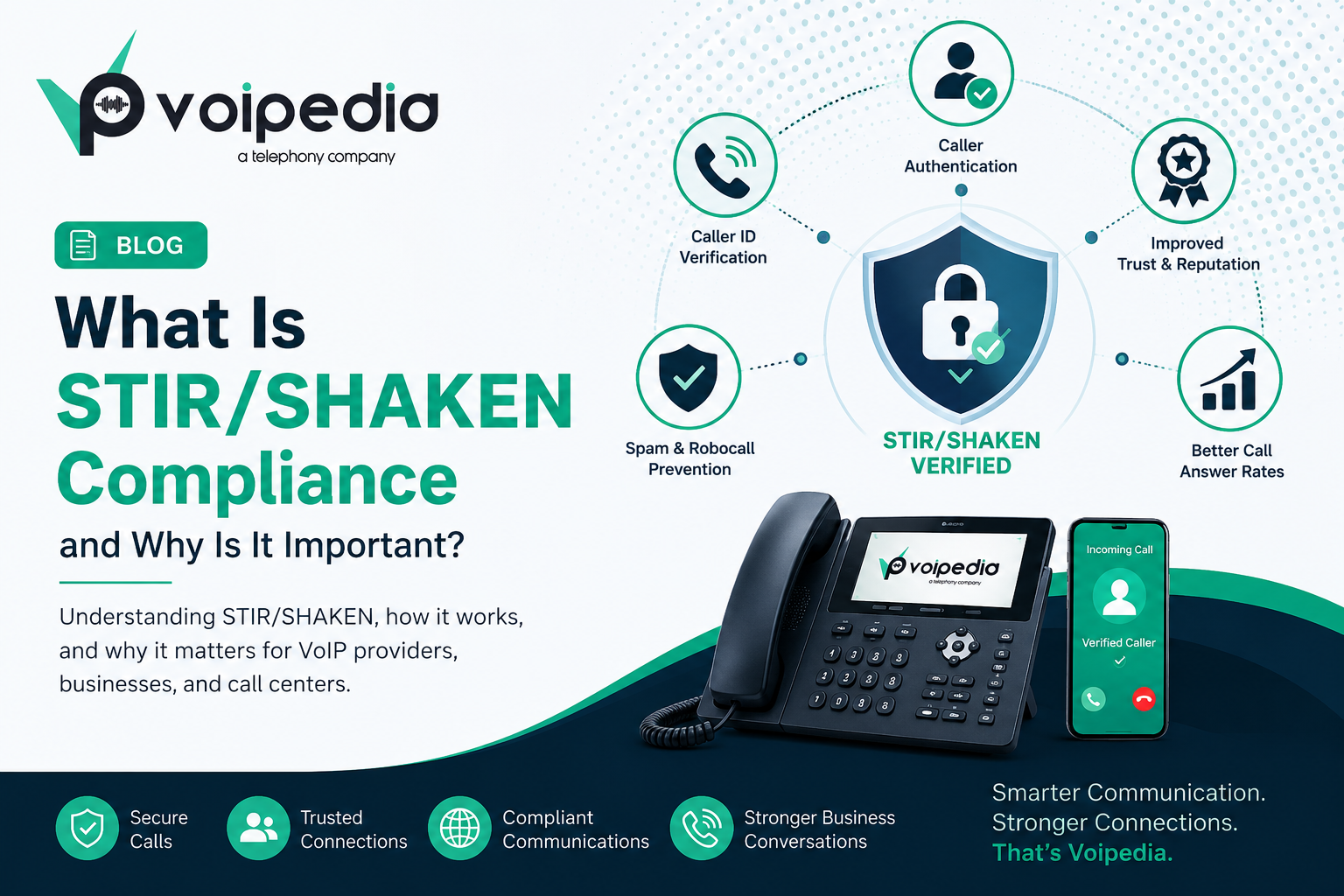
What Is STIR/SHAKEN Compliance and Why Is It Important?

Businesses today depend heavily on voice communication, but trust in phone calls has declined dramatically over the last few years. Spam calls, robocalls, and caller ID spoofing have made customers hesitant to answer unknown numbers. This growing telecom problem is exactly why STIR/SHAKEN compliance has become essential for modern VoIP providers, SIP carriers, contact centers, and enterprise communication systems.

STIR/SHAKEN is designed to verify caller identity, reduce spoofed calls, and help telecom providers restore trust in voice communication. As regulations tighten and carriers become stricter about spam prevention, businesses that ignore STIR/SHAKEN compliance may face lower answer rates, spam labeling, and reduced call deliverability.

If your company uses VoIP services or outbound calling systems, understanding how STIR/SHAKEN works is no longer optional.

You can also learn more about modern communication infrastructure in our guide on
https://thevoipedia.com/cloud-pbx-vs-traditional-phone-systems/

What Is STIR/SHAKEN Compliance?

STIR/SHAKEN is a caller authentication framework used to verify that a phone call is genuinely coming from the number displayed on caller ID.

The framework combines two telecom standards:

  • STIR — Secure Telephone Identity Revisited
  • SHAKEN — Signature-based Handling of Asserted Information Using toKENs

Together, these standards help telecom providers digitally sign and verify calls across IP-based VoIP networks.

The Federal Communications Commission (FCC) introduced STIR/SHAKEN as part of its broader effort to reduce illegal robocalls and caller ID spoofing.
https://www.fcc.gov/call-authentication

Why STIR/SHAKEN Was Introduced

Before STIR/SHAKEN, scammers could easily manipulate caller IDs using VoIP systems. Fraudsters often impersonated:

  • Banks
  • Government agencies
  • Healthcare providers
  • Insurance companies
  • Customer support teams

As spoofing became more common, customers stopped trusting incoming calls. Even legitimate businesses began struggling with declining answer rates.

Telecom providers and regulators needed a scalable solution that could authenticate caller identity across modern SIP networks. STIR/SHAKEN was created to solve this growing issue.

Businesses using scalable communication platforms like modern cloud PBX systems are increasingly adopting authentication frameworks to improve call trust and delivery.
https://thevoipedia.com/global-voip-solutions-businesses/

How STIR/SHAKEN Works

The STIR/SHAKEN framework works through digital certificates and SIP authentication.

Here’s a simplified process:

  1. A VoIP call is initiated.
  2. The originating provider verifies the customer.
  3. The provider digitally signs the call.
  4. A SIP Identity header and PASSporT token are attached.
  5. The receiving carrier verifies the signature.
  6. The call receives a trust verification level.

This entire process happens in milliseconds without affecting audio quality or call performance.

Understanding STIR/SHAKEN Attestation Levels

One of the most important aspects of STIR/SHAKEN compliance is attestation.

Attestation levels indicate how confidently the originating provider can verify the caller identity.

Full Attestation (A-Level)

The provider:

  • Knows the customer
  • Authenticated the customer
  • Confirms ownership of the phone number

This is the highest trust level.

Partial Attestation (B-Level)

The provider knows the customer but cannot fully verify ownership of the caller ID number.

Gateway Attestation (C-Level)

The provider received the call from another network and cannot verify the original caller.

Calls with lower attestation levels are more likely to trigger spam analytics systems.

More technical details about STIR/SHAKEN standards can be found here:
https://sti-ga.atis.org/

Why STIR/SHAKEN Compliance Is Important

Better Call Answer Rates

One of the biggest benefits of STIR/SHAKEN compliance is improved call answer rates.

Modern carriers increasingly prioritize authenticated traffic. Calls without verification are more likely to:

  • Display “Spam Likely”
  • Be blocked
  • Receive lower trust scores
  • Experience poor connection rates

For outbound sales teams and call centers, this directly impacts campaign performance and revenue generation.

Caller ID Spoofing Prevention

Caller ID spoofing damages customer trust and brand reputation.

STIR/SHAKEN helps telecom providers reduce fraudulent impersonation attempts and improve the credibility of legitimate business calls.

Regulatory Compliance

In the United States, the FCC requires many voice service providers to implement STIR/SHAKEN on IP-based networks as part of robocall mitigation requirements.

Failure to comply can create operational and regulatory risks for telecom providers and VoIP businesses.

Additional information about telecom identity frameworks can be found here:
https://www.iconectiv.com/stir-shaken

Improved Carrier Reputation

Carriers constantly analyze traffic quality.

Businesses sending authenticated traffic often experience:

  • Better routing quality
  • Improved termination rates
  • Lower spam labeling
  • Stronger carrier relationships

This is especially important for companies operating large outbound call campaigns.

Why Call Centers Need STIR/SHAKEN

Modern contact centers rely heavily on outbound communication.

Without caller authentication, even legitimate business calls may appear suspicious to recipients. This results in:

  • Lower pickup rates
  • Reduced agent productivity
  • Increased spam labeling
  • Poor campaign performance

STIR/SHAKEN compliance helps contact centers maintain trusted outbound communication while improving answer rates.

Common Challenges with STIR/SHAKEN

Legacy Infrastructure

Older telecom systems based on TDM or SS7 networks may face interoperability challenges when integrating STIR/SHAKEN.

International Traffic

Cross-border authentication remains complex because countries implement different telecom verification standards.

Spam Analytics Still Matter

Even authenticated calls can still be flagged if dialing behavior appears suspicious.

Carriers also evaluate:

  • Complaint rates
  • Call frequency
  • Traffic patterns
  • Consumer feedback

This means businesses must combine authentication with responsible outbound practices.

Does STIR/SHAKEN Stop All Robocalls?

No.

STIR/SHAKEN significantly reduces caller ID spoofing, but it does not eliminate all robocalls.

Scammers may still:

  • Use valid phone numbers
  • Exploit compromised systems
  • Route traffic internationally
  • Abuse non-IP networks

However, STIR/SHAKEN remains one of the most important telecom security improvements introduced in recent years.

Best Practices for STIR/SHAKEN Compliance

Businesses can improve their telecom reputation by:

  • Using verified caller IDs
  • Maintaining compliant dialing practices
  • Monitoring spam analytics
  • Working with trusted SIP carriers
  • Registering outbound campaigns
  • Avoiding aggressive robocall behavior

The Future of STIR/SHAKEN

The telecom industry continues evolving toward stronger caller verification systems.

Future developments may include:

  • Verified branded calling
  • Rich call data
  • AI-driven fraud prevention
  • Enhanced cross-border authentication
  • Advanced telecom identity frameworks

The long-term goal is clear: restore trust in voice communication.

Final Thoughts

STIR/SHAKEN compliance has become a critical part of modern VoIP infrastructure.

As robocalls and caller ID spoofing continue affecting the telecom industry, businesses must prioritize authenticated voice communication to maintain answer rates, customer trust, and carrier reputation.

For VoIP providers, SIP trunk operators, cloud PBX platforms, and enterprise contact centers, STIR/SHAKEN is no longer just a regulatory requirement — it is becoming a business necessity.

Cloud PBX vs Traditional Phone Systems: Why Modern Businesses Are Making the Switch

Introduction

Business communication has undergone a fundamental transformation over the past decade. What was once dominated by hardware-heavy, location-bound telephone systems has now evolved into flexible, cloud-based infrastructures that support global operations in real time.

For organizations evaluating their communication stack, the decision is no longer whether to modernize—but how quickly they can transition to a more scalable and efficient system.

This article explores the differences between traditional phone systems and cloud-based PBX solutions, and why companies are increasingly choosing providers like Voipedia to power their communication infrastructure.

What Is a Traditional Phone System?

Traditional telephony systems rely on physical Private Branch Exchange (PBX) hardware installed on-premise. These systems route calls through dedicated lines and require ongoing maintenance, upgrades, and operational oversight.

While historically reliable, they present several limitations:

  • High upfront capital expenditure
  • Limited scalability
  • Geographic constraints
  • Complex maintenance requirements

As businesses expand and adopt remote or hybrid work models, these limitations become increasingly restrictive.

What Is Cloud PBX?

Cloud PBX is a software-based communication system hosted on remote servers and delivered via the internet. Instead of managing physical infrastructure, businesses can access enterprise-grade telephony features through a centralized platform.

Core capabilities include:

  • Virtual call routing and IVR systems
  • Real-time analytics and reporting
  • Multi-device support (desktop, mobile, softphone)
  • Seamless integration with CRM and third-party tools

This shift eliminates hardware dependency and enables businesses to operate with greater agility.

Key Differences: Cloud PBX vs Traditional Systems

Feature Traditional PBX Cloud PBX
Infrastructure On-premise hardware Cloud-based
Scalability Limited Highly scalable
Setup Time Weeks Hours or days
Maintenance Manual & costly Managed by provider
Remote Access Restricted Fully accessible
Cost Structure High upfront cost Subscription-based

The contrast clearly highlights why cloud-based systems are better aligned with modern business needs.

Why Businesses Are Moving to Cloud PBX

1. Scalability Without Complexity

Cloud PBX allows organizations to scale operations instantly. Whether adding new users, expanding into new regions, or launching new campaigns, the infrastructure adapts without requiring additional hardware.

2. Cost Efficiency

Traditional systems involve significant capital investment and ongoing maintenance costs. Cloud PBX operates on a predictable subscription model, reducing financial risk and improving budget control.

3. Global Accessibility

Modern businesses are no longer confined to a single location. Cloud PBX enables teams to operate from anywhere while maintaining a unified communication system.

This is particularly valuable for:

  • Remote teams
  • International call centers
  • Distributed sales operations

4. Advanced Features and Automation

Cloud-based systems offer capabilities that are difficult or expensive to implement in traditional setups:

  • Intelligent call routing
  • Automated IVR systems
  • Call recording and analytics
  • Performance tracking dashboards

These features enhance both operational efficiency and customer experience.

5. Faster Deployment

Deploying a traditional PBX system can take weeks. In contrast, cloud PBX solutions can be implemented in a matter of hours, allowing businesses to go live quickly and respond to market demands.

How Voipedia Delivers Cloud PBX at Scale

Voipedia’s cloud PBX platform is designed to meet the needs of modern enterprises and high-volume communication environments.

Key advantages include:

  • Customizable workflows: Tailor call routing and system behavior to match business processes
  • High-quality voice infrastructure: Ensures consistent call clarity across regions
  • Global number coverage: Enables businesses to establish a local presence worldwide
  • Integrated communication stack: Combines voice, messaging, and connectivity into one platform

This integrated approach allows businesses to manage their entire communication ecosystem through a single provider.

Use Cases Across Industries

Cloud PBX is not limited to one sector. Its flexibility makes it suitable for a wide range of industries:

Call Centers

Manage high call volumes with intelligent routing and performance analytics.

E-commerce

Provide real-time customer support and order updates through integrated communication channels.

Financial Services

Ensure secure, reliable communication with clients while maintaining compliance standards.

Healthcare

Enable appointment scheduling, reminders, and patient communication with minimal latency.

Future Outlook: Communication as a Strategic Asset

The role of communication technology is evolving from a support function to a core business driver. Organizations that invest in scalable, cloud-based systems gain a competitive advantage through:

  • Faster response times
  • Improved customer engagement
  • Data-driven decision making
  • Reduced operational overhead

Cloud PBX is no longer just an upgrade—it is a strategic necessity.

Conclusion

The transition from traditional phone systems to cloud PBX represents a fundamental shift in how businesses communicate, operate, and scale.

With its advanced infrastructure and comprehensive service offering, Voipedia enables organizations to modernize their communication stack and prepare for future growth.

For businesses still relying on legacy systems, the question is no longer whether to switch—but how soon they can take advantage of the efficiencies and capabilities that cloud-based communication provides.

Global VoIP Solutions for Businesses: How Voipedia Powers Modern Call Centers

Introduction

VoIP PBX solutions are transforming how modern businesses manage communication. In today’s digital environment, companies need scalable, flexible, and cost-efficient systems to handle global operations efficiently.

Cloud-based VoIP platforms have emerged as the foundation for this transformation. Among these providers, Voipedia delivers a comprehensive suite of communication solutions designed specifically for enterprises, call centers, and telecom-driven businesses.

This article examines how Voipedia supports modern communication needs and why its infrastructure is increasingly relevant in a competitive global market.

The Evolution of Business Telephony

Traditional telephony systems—characterized by physical PBX hardware and limited geographic flexibility—are rapidly being replaced by software-defined communication platforms.

VoIP (Voice over Internet Protocol) enables organizations to transmit voice traffic over IP networks, eliminating dependency on legacy systems. The shift provides several structural advantages:

  • Reduced operational and infrastructure costs
  • Rapid deployment across multiple regions
  • Seamless integration with CRM and business systems
  • Enhanced analytics and performance monitoring

For high-volume communication environments such as contact centers, these capabilities are no longer optional—they are critical.

Voipedia’s Communication Ecosystem

1. Cloud-Native PBX Architecture

Voipedia’s cloud PBX solutions remove the need for on-premise hardware while delivering enterprise-grade functionality. Organizations can deploy and manage communication workflows through a centralized, scalable platform.

Core capabilities include:

  • Intelligent call routing and IVR systems
  • Real-time call monitoring and reporting
  • Multi-device accessibility (desktop, mobile, softphones)
  • Customizable workflows aligned with business logic

This architecture enables operational flexibility without compromising control or performance.

2. Inbound Communication Optimization

Customer experience is largely defined by how efficiently inbound communication is handled. Voipedia’s inbound solutions are designed to minimize latency, improve routing accuracy, and ensure high availability.

Key advantages:

  • Smart routing based on geography, availability, or priority
  • Reduced wait times through automation
  • Improved first-call resolution rates

These features directly contribute to higher customer satisfaction and retention.

3. Scalable Outbound Communication Systems

Outbound communication remains a critical driver for revenue-focused operations, particularly in sales and lead generation environments.

Voipedia supports outbound workflows with:

  • High-throughput dialing capabilities
  • Consistent voice quality across regions
  • Configurable campaign structures

This allows organizations to execute large-scale outbound campaigns with precision and efficiency.

4. Global DID and Toll-Free Infrastructure

Establishing a local presence in international markets is essential for building trust and improving accessibility. Voipedia provides extensive DID (Direct Inward Dialing) and toll-free number coverage across multiple countries.

Strategic benefits include:

  • Localized customer engagement without physical offices
  • Improved answer rates due to familiar number formats
  • Cost-effective global expansion

5. Carrier-Grade Messaging Solutions

In addition to voice, Voipedia integrates bulk messaging capabilities that enable businesses to deliver time-sensitive information at scale.

Use cases include:

  • Transactional notifications
  • Marketing campaigns
  • Customer alerts and reminders

The integration of voice and messaging into a unified platform enhances communication consistency and operational efficiency.

6. SIP Trunking and Dedicated Connectivity

For enterprises requiring high reliability and control, Voipedia offers SIP trunking and dedicated line infrastructure. This ensures stable connectivity and optimized call quality for mission-critical operations.

Capabilities include:

  • Direct integration with existing telephony systems
  • High-availability routing
  • Scalable channel capacity based on demand

Competitive Positioning in the VoIP Market

Voipedia differentiates itself through a combination of infrastructure depth and operational focus.

Global Scalability

The platform supports businesses operating across multiple geographies, enabling rapid market entry without infrastructure constraints.

Call Center-Centric Design

Unlike generic VoIP providers, Voipedia is architected with high-volume communication environments in mind, making it particularly suited for contact centers.

Performance and Reliability

Carrier-grade routing and network optimization ensure consistent call quality, which is critical for customer-facing operations.

Outcome-Oriented Approach

Beyond providing services, Voipedia enables measurable improvements in efficiency, responsiveness, and revenue generation.

Strategic Impact on Business Operations

Adopting a platform like Voipedia has direct implications across multiple business functions:

  • Operations: Streamlined workflows and reduced infrastructure overhead
  • Sales: Improved outreach capabilities and campaign scalability
  • Customer Support: Faster response times and higher service quality
  • Expansion: Simplified entry into new markets

This alignment between technology and business outcomes is what defines modern communication platforms.

Conclusion

As enterprises continue to scale globally and customer expectations rise, the importance of robust, flexible communication infrastructure will only increase.

Voipedia represents a shift toward integrated, cloud-based communication ecosystems that support both operational efficiency and strategic growth. For organizations seeking to modernize their telephony infrastructure, the platform offers a comprehensive solution aligned with the demands of today’s business environment.